TEAMscan Experience Guide: Discuss Results With Your Team
 Updated
by
Amy Thomas
Updated
by
Amy Thomas
After taking the TEAMscan at the team, department, or organisational level, the best practice is to create time and space for people to reflect on the TEAMscan insight report and discuss it together as a group. This shared reflection and conversation should lead to a single, committed action plan (one experiment) that improves teamwork over the next 2–8 weeks.
Before you meet: Get ready for a useful conversation
Confirm the basics
- Check results availability: TEAMscan results appear after 3+ responses. If you don’t see results yet, check the completion list and send reminders.
- Set expectations: TEAMscan takes about 5 minutes to complete.
- Use TEAMscan with the right teams: teams that work together regularly and have 3+ members.
Use Coach Bo to prepare
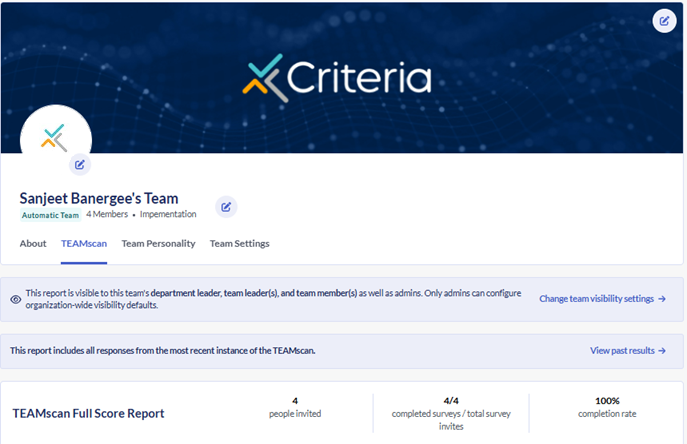
Open your team’s TEAMscan report in Develop and launch Coach Bo from that page so Bo can give context-aware help. Here are some helpful prompts:
“What are our key strengths and challenges based on this TEAMscan?”
“What’s one small experiment we can run for the next 30 days to improve our lowest scoring area?”
“Help me build an action plan based on these results.”
Schedule the discussion
Choose a time when your team can be focused and present.
- Schedule a time when you and your teammates can talk in an environment that’s free from distractions, focused, but relaxed.
- Block out at least 30–60 minutes.
- Avoid doing this when team members are stressed or under heavy job-related pressure.
Run the discussion
Start by setting the tone and framing the purpose.
- Remind everyone: this is a safe place to talk openly about what the team is doing well and where the team can grow.
Ground rules
Use these verbatim if this is helpful.
✅ Be positive and supportive.
✅ This is a safe space to try, learn, and improve as a team (growth mindset).
✅ Describe things without judgment or blame.
✅ Be future focused.
✅ Not a place to raise (or solve) conflicts or argue.
✅ Take turns and invite everyone into the conversation.
✅ If you’re the team leader:
- Invite everyone in
- Encourage turn-taking and topic switching
- Ask clarifying questions (when/how/what) and extending questions (what if)
- Summarise progress and next steps
Suggested discussion flow
Use this sequence to keep the conversation productive:
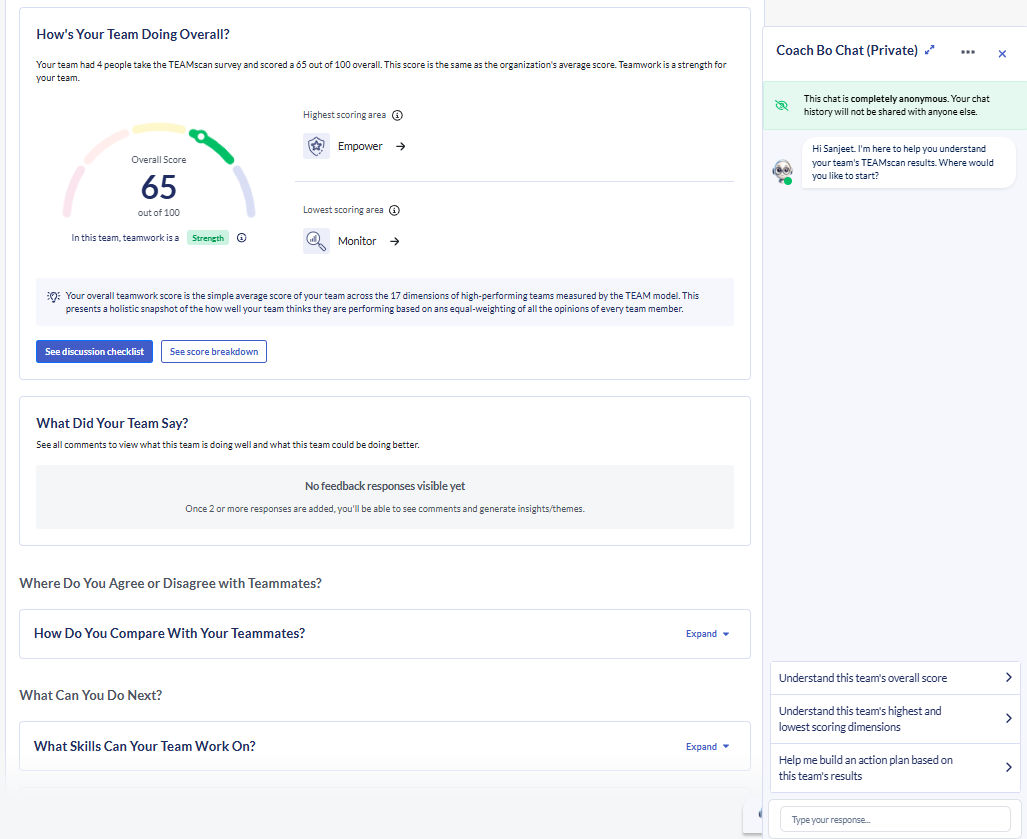
- Overall score: Does it feel accurate? Too high/too low?
- Highest scoring dimension: What are 1–2 examples of when we do this well? How do we do more of it?
- Lowest scoring dimension: Does this limit performance or enjoyment? What’s one small change we could test?
- Comments/themes: What patterns show up? What’s actionable?
Commit to an Action Plan (choose ONE experiment)
Your goal is not to fix everything. Your goal is one clear, lightweight experiment the team can actually practice.
Make sure your action plan includes:
The What | What specifically you will try and do. Choose one focus:
|
The Why | Why improving at this skill or dimension matters to you as a team |
The How | What standing meeting or existing process you will connect this to (e.g., weekly team meeting, standup, project retro) |
What success is
💡 Success is a clear definition of the improvement you hope to see. For example: “decisions are made faster,” “fewer meeting rework loops,” “more clarity on priorities”.
Set the next check-in time and date
Set a check-in date 2–8 weeks in the future (about one month often works well).
- If it’s longer, it’s too far away to motivate behavior and too infrequent to drive learning.
- If it’s more frequent, it can become distracting from day-to-day execution.
Optional (but powerful): Plan to run your next TEAMscan at the end of the cycle so you can measure what changed.
Common challenges (and what to do)
❌ Not enough completions to see results (fewer than 3 responses)
Remind people it’s ~5 minutes; send reminders; consider completing in a live meeting.
❌ The conversation becomes blame-focused or derails into solving every problem at once
If the discussion gets tense, return to ground rules and redirect to “one experiment we can try”.
❌ The team agrees on ideas but leaves without one clear experiment
If the scope grows, enforce the constraint: one experiment, one meeting, one timeframe
❌ No follow-through because the experiment isn’t tied to a recurring meeting
If follow-through is weak, put the experiment into the next recurring meeting agenda immediately
What to do next
To build momentum after your team meeting:
- Send a short summary to the team: the one experiment, where it will happen, and the check-in date.
- Add the experiment to the agenda of the recurring meeting you selected.
- At each meeting, spend 5–15 minutes practicing/reviewing the experiment.
- At the check-in (2–8 weeks), review:
- what worked / what didn’t
- whether to iterate, replace, or scale the experiment
- whether to re-run TEAMscan to measure progress
