Team Development Session Guide for Managers
 Updated
by
Amy Thomas
Updated
by
Amy Thomas
Use this guide to run a practical, high-impact team development session in Develop. Choose your session type (TEAMscan results review or Team Personality discussion), use Coach Bo to prepare, and guide your team through a structured conversation that ends with one clear experiment to try over the next few weeks.
The goal isn’t to “fix everything” in a single meeting - it’s to build a simple, repeatable rhythm that strengthens your team through small steps and continuous improvement.
Before the Session
Schedule a 60 minute session with your team to either:
- Discuss your Team Personality Report: build the 4 C's and maximize team potential
- Review your TEAMscan results: interpret the results and discuss with your team
Send a calendar invitation with clear expectations. Full participation is necessary to ensure the maximum impact for the whole team.
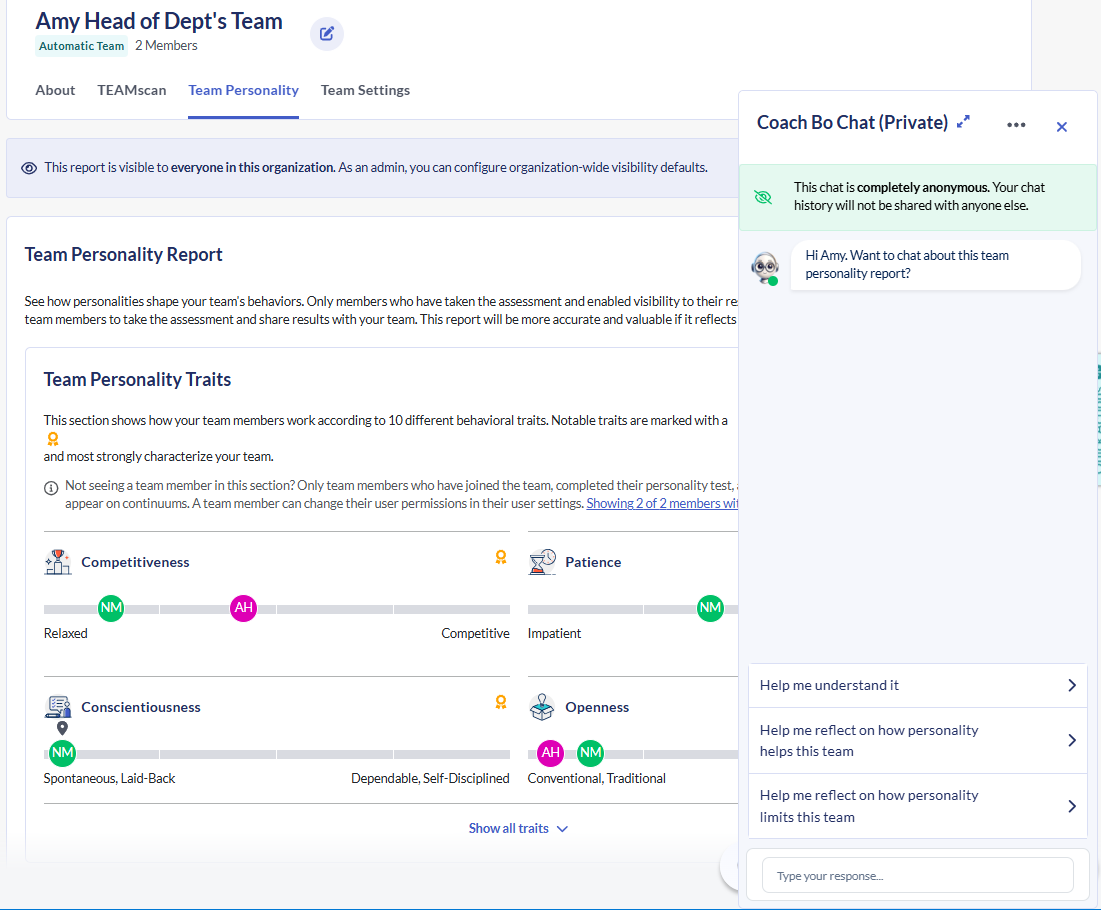
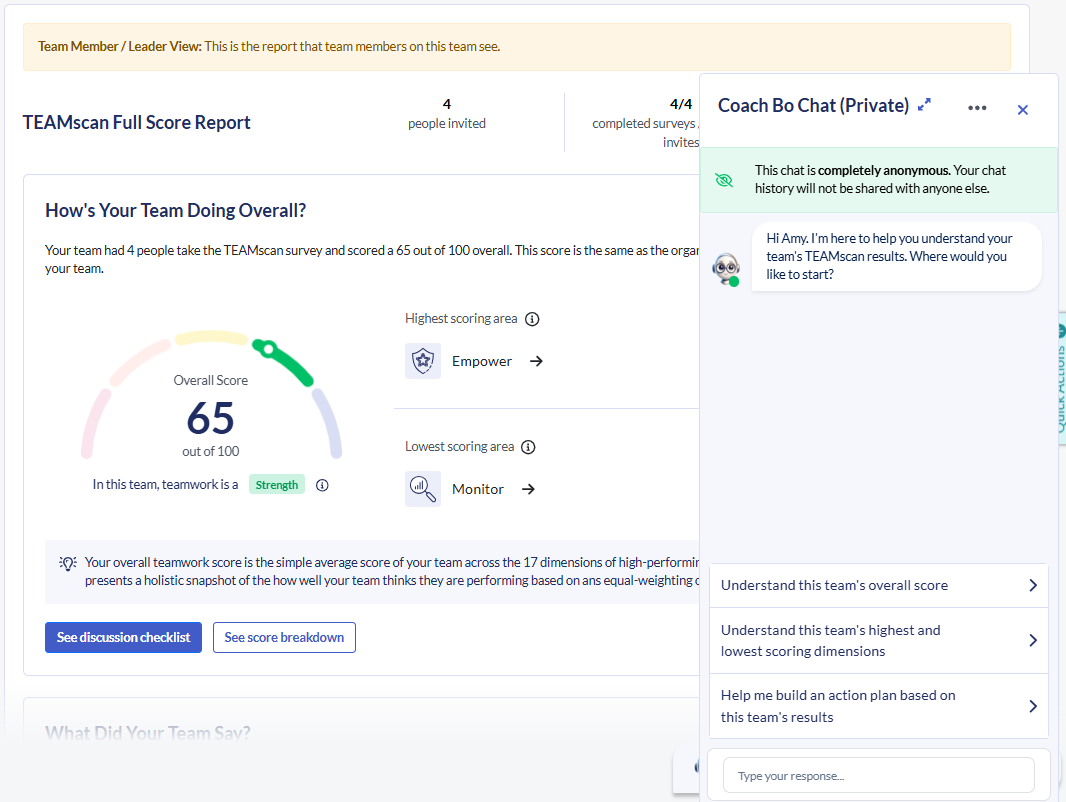
Chat to Coach Bo to prepare for the session. When you open the chat window from within the Team Personality Report or the TEAMscan results, Bo will focus on assisting you with questions about these.
Team Personality Report
TEAMscan
During the Session
Here are our recommended time frames.
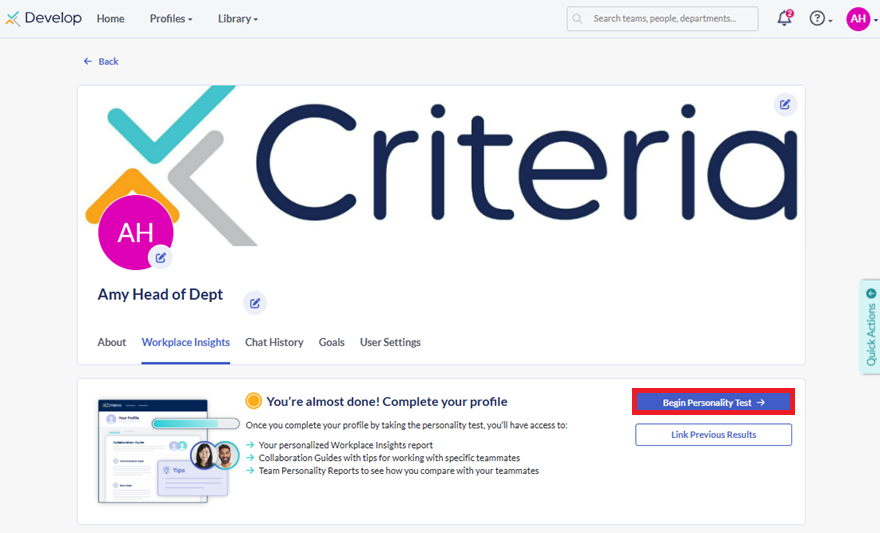
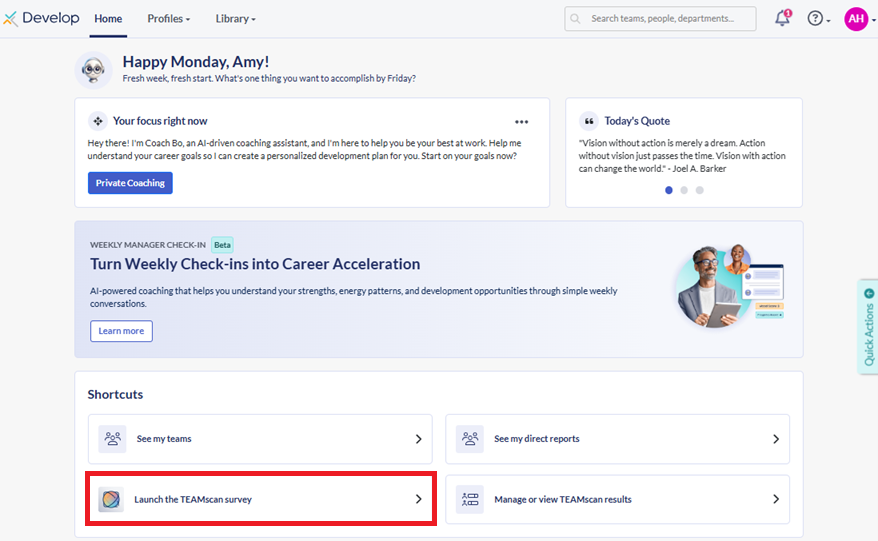
- First 15 minutes: Session kick-off and assessment/survey completion (if not completed prior to session)
Team Personality Report
TEAMscan
- Middle 30 minutes: Results review and discussion
Team Personality Report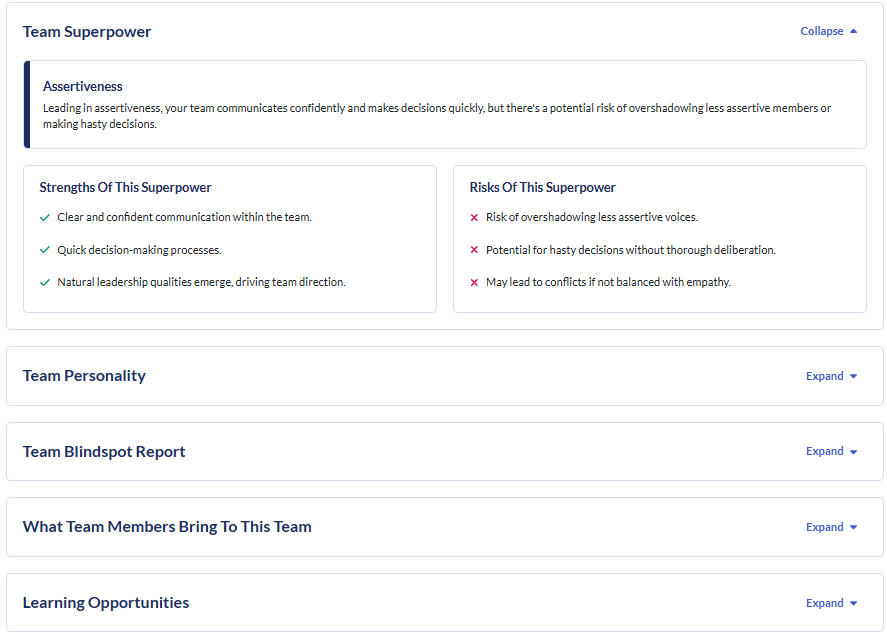
TEAMscan
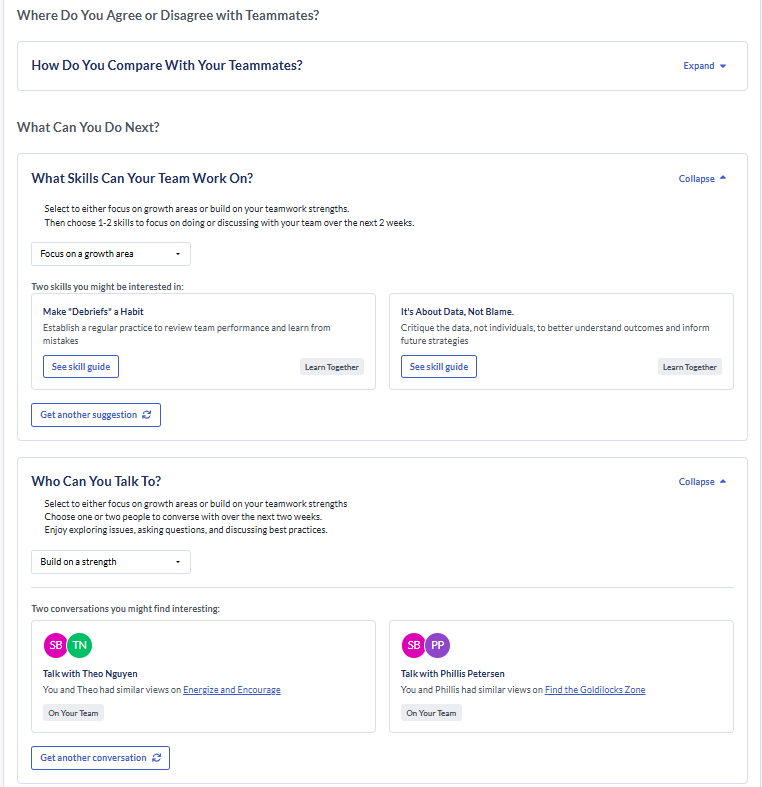
- Final 15 minutes: Choose one experiment to try
What good outcomes look like
✅ Participation is high and timely: Team completes the TEAMscan or team members have EPP completed/linked.
✅ Shared understanding, not just “data review”: Team can clearly name: (1) top strengths, (2) lowest area / biggest opportunity, and (3) what’s driving those results (themes + examples).
✅ Psychological safety is protected: Discussion stays future-focused and constructive (no blaming, no “calling people out”).
✅ One clear, lightweight experiment is chosen: A single team commitment for the next 2–8 weeks (often ~30 days), tied to an existing recurring meeting.
✅ A follow-up date exists: Next check-in is scheduled and visible on calendars; your team knows what will be reviewed.
✅ Momentum starts immediately: The chosen practice shows up in the next team meeting/weekly rhythm (not postponed “until things calm down”).
After the Session
Send a follow-up summary to your team. Thank them for their participation and outline what you reviewed, the single experiment chosen, who owns it, and where it will happen (which meeting).
Schedule your next check-in with your team and plan your next steps.
Add a standing agenda item (15–20 minutes) in the recurring team meeting to practice/review.
How to build momentum
*️⃣ Create “small wins” visibility: Call out concrete examples of the new behavior in meetings. Recognize participation and improvements (especially early).
*️⃣ Keep the loop tight: Measure → Focus → Practice → Check-in → Repeat.
*️⃣ Use data as feedback, not judgment: Treat TEAMscan and Check-ins as signals to iterate on your experiment.
How to measure progress
Use a mix of adoption + behavior + outcome signals to measure the success of your experiment.
✅ Adoption / completion: TEAMscan or personality assessment completion rate.
✅ Execution: Did the team run the experiment at least 3 times (e.g., in 3 weekly meetings) within the cycle? Is the experiment documented (what/why/how) and owned by someone?
✅ Leading indicators (1–4 weeks): Fewer repeated blockers/themes in Weekly Check-ins insights (if enabled). Team members can cite specific examples of “we did X differently.”
✅ Lagging indicators (next TEAMscan cycle): Improvement in the one selected dimension (and/or improved agreement/clarity in comments). Stability or lift in overall TEAM score (recognizing scores can fluctuate).
When to adjust course
Adjust quickly when you see any of the following:
❌ Low signal / low trust: The TEAMscan completion is fewer than 3 responses (no report) or there is consistently low participation. The team is hesitant to speak or discussion becomes defensive.
❌ The action plan is too big or too vague: Multiple goals, no clear behavior to address, not connected to a standing meeting.
❌ No behavior change after 2–3 weeks: The team can’t point to concrete moments where the new practice happened.
❌ Weekly Check-ins show sustained strain: Team members' mood or energy is trending down (especially repeated), recurring burnout/turnover risk flags, or “IMMEDIATE” issues repeating week over week.
❌ Mismatch between results and lived experience: If the team believes results are “off,” use it as a prompt to clarify context and refine what you’re testing (don’t argue the score).
When to move to the next phase
Your team will be ready to move on to the next phase when one of these happens:
💡 The experiment is embedded: It’s happening routinely without extra effort.
💡 You’ve learned what works: Either the TEAMscan dimension improved, or you have clear evidence the experiment didn’t help and you’re ready to pivot.
💡 The team is ready for a new focus: After the planned timeframe (2–8 weeks) and a review discussion, select the next single focus area for the next cycle (or broaden from team-level to department-level if you’re scaling).
How to handle issues and objections
✳️ People don’t complete the TEAMscan or personality assessment in time: Busy schedules, email fatigue, uncertainty about anonymity/intent.
✳️ Not enough responses to generate results: TEAMscan requires 3+ respondents for results visibility.
Set expectations in the invitation. TEAMscan takes just 5 minutes and the personality assessment takes around 10 minutes.
Allow time in your session for the team to complete the assessment or survey.
Send reminders to the team to complete the assessment or survey.
✳️ Discussion turns into blame, debate, or problem-solving spirals: Especially around low-scoring dimensions or comments.
✳️ Unclear privacy boundaries: Confusion between Coach Bo Chats (confidential) vs Weekly Manager Check-ins (summarized insights go to managers/leaders).
Protect your team's psychological safety. Start with ground rules (positive, supportive, no judgment, future-focused).
If conflict appears: park it and redirect to “What experiment can we try next?”
✳️ Over-scoping: Team tries to fix everything; leaves with no single experiment.
Force a constraint: “One dimension, one skill, one meeting, one timeframe.”
If multiple needs emerge, place them in a backlog for future cycles.
✳️ Unclear privacy boundaries: Confusion between Coach Bo Chats (confidential) vs Weekly Manager Check-ins (summarized insights go to managers/leaders).
Clarify privacy: Bo Chats from the in-app icon are confidential; Weekly Check-ins are analyzed and surfaced as insights to managers.
✳️ You feel unprepared to facilitate: You haven’t reviewed the report, haven’t used Bo to prep, or don’t know what “good” looks like.
Launch Coach Bo from the relevant context (TEAMscan report / Team Personality) and ask for:
- a discussion agenda, prompts, and a 30-day challenge
- a lightweight action plan tied to your meeting cadence
✳️ No follow-through: Great session, but no recurring cadence to practice/review.
Add a recurring agenda item in your regular team meeting to practice/review.
